
At a recent Guild meeting, we had the pleasure of welcoming textile artist Anne Kelly (based in Kent, England, with deep ties to Canada) for an inspiring presentation titled Artist Life. Her talk offered a generous and heartfelt look into her creative practice — a body of work developed over more than a decade, rooted in place, memory, collaboration, and storytelling through cloth.
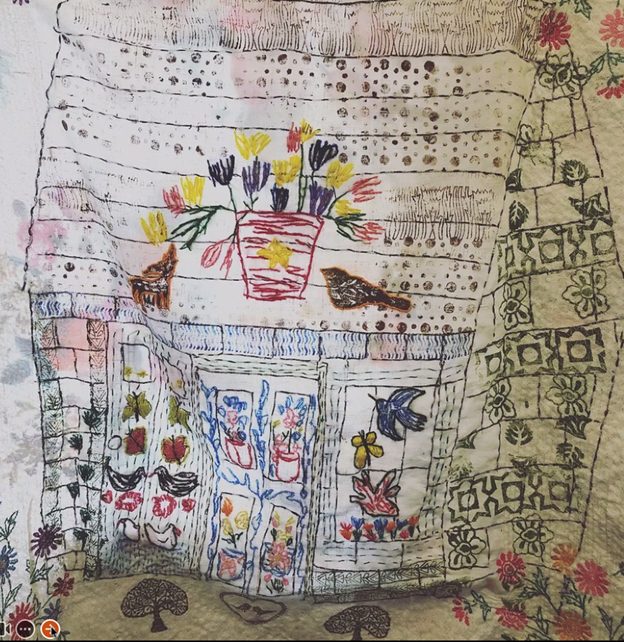
Anne began by reflecting on her journey from studying fine art at Mount Allison University in New Brunswick to settling in the UK after receiving travel grants early in her career. Though she now lives and works in a garden studio in southeast England, her life and art continue to move fluidly between Canada and the UK, weaving together both landscapes and histories.
Rather than presenting a chronological overview, Anne organized her talk around recurring themes in her work:
Place and Nature
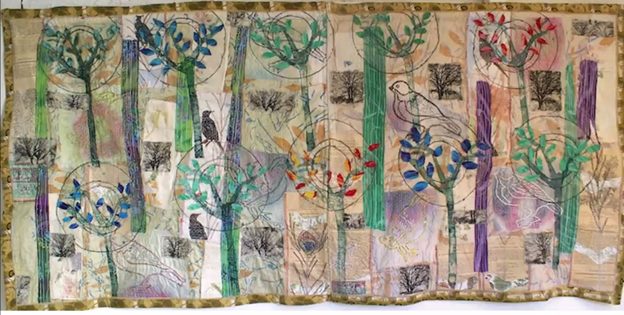
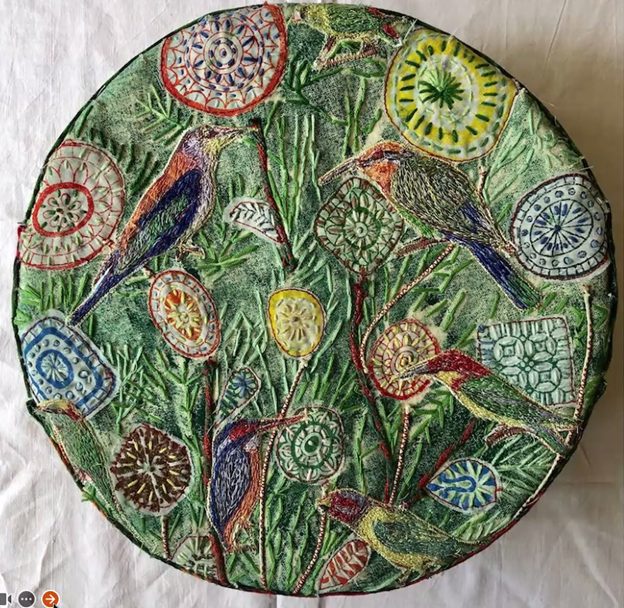
Drawing inspiration from gardens, wild landscapes, and birds, Anne’s layered textile collages often begin with observation and sketching. Botanical studies, birds in decline, and community-based conservation projects have all informed her richly stitched surfaces. Her work for the Royal Society for the Protection of Birds (RSPB), for example, combined art with advocacy and public participation.
Community and Public Art
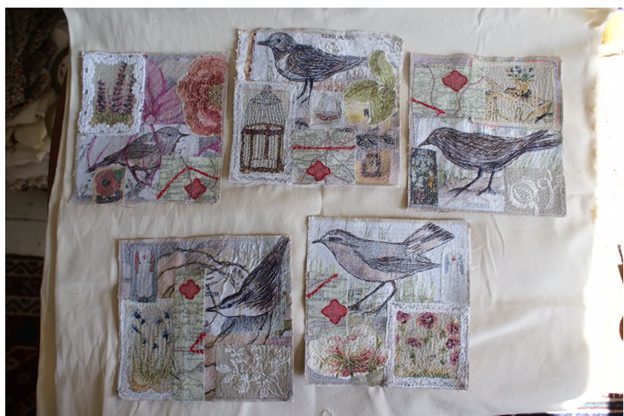
Anne has completed several public commissions, including installations for healthcare spaces and community centres. One notable project honoured suffragist and hospital founder Amelia Scott, incorporating imagery of local birds and historical references meaningful to her town. Her philosophy is simple: artwork should live in the world, not remain hidden in a studio.
Repurposing and Renewal
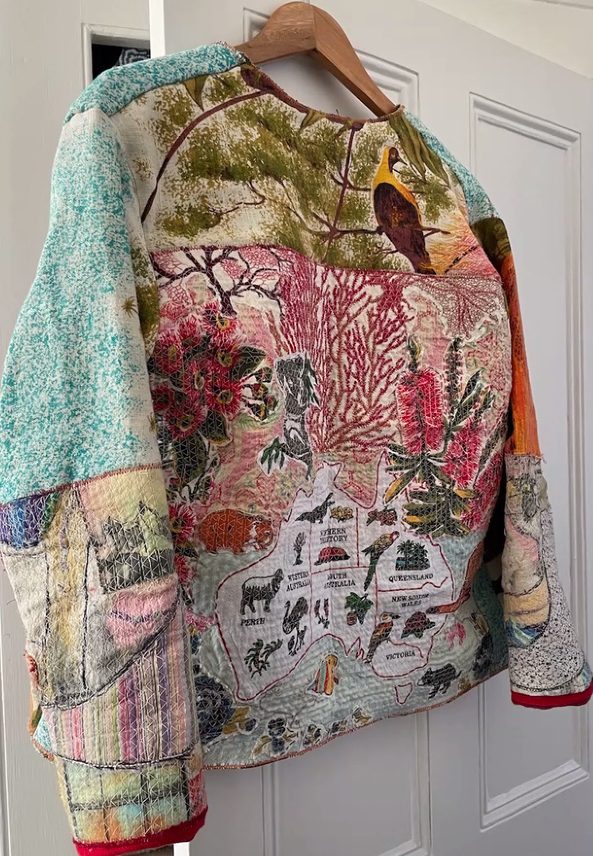
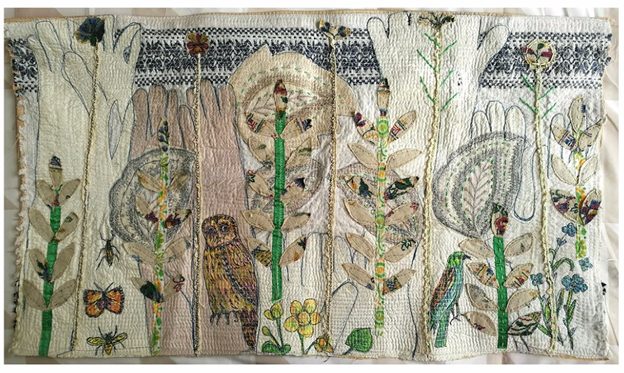
A hallmark of Anne’s practice is her commitment to using reclaimed materials — old garments, heirloom linens, maps, quilts, gloves, aprons, and tablecloths. She speaks passionately about “giving fabric new life,” encouraging artists not to let meaningful textiles languish in drawers. By cutting, layering, and stitching these materials into new forms, she honours their histories while allowing them to evolve.
Travel and Cultural Exchange
Anne’s teaching has taken her around the world — to France, Italy, India, Australia, Japan, and across Canada. Each place informs her work, whether through collaborative community projects, artist residencies, or exhibitions such as World of Threads in Oakville and her upcoming exhibition at the Mississippi Valley Textile Museum. Travel sketchbooks and folding books often accompany her journeys, serving as both creative anchor and personal reflection.
Family and Memory
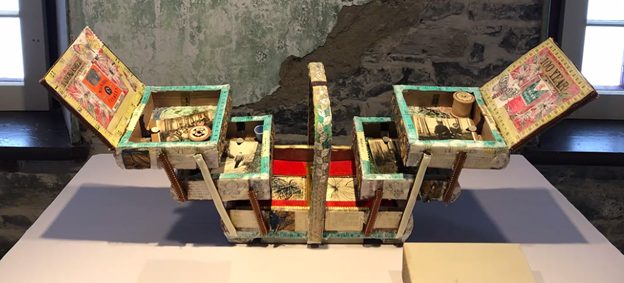
Many works explore ancestry and identity — from Canadian wartime family histories to broader reflections on belonging in a post-Brexit world. A particularly moving piece transformed her grandmother’s deteriorating sewing box into a layered textile homage, blending photography, stitch, and memory.
Experimentation and Technique
Anne frequently combines fabric with paper using a glue-and-tissue technique that allows her to stitch into delicate surfaces such as maps and book pages. She encourages artists to experiment fearlessly — but to start small with samples before committing to large works.
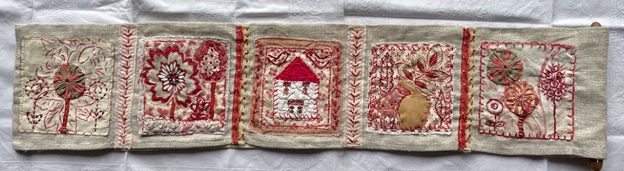
During Q&A, Anne spoke candidly about her working rhythm. She considers two full studio days per week a success and keeps small project baskets around the house for moments of quiet stitching — making creativity accessible rather than overwhelming.
Research varies by project. Some works begin with a piece of fabric or an intuitive response; others, such as a recent commission for the Jodrell Bank Observatory, required deep historical and cultural investigation to respectfully engage the community connected to the site. When inviting community contributions for exhibitions, Anne chooses not to jury submissions, believing that varied experience levels enrich rather than diminish a collective project. In an era often dominated by curated perfection, her approach emphasizes generosity, encouragement, and shared storytelling.
From large-scale installations to intimate folding books, Anne’s work demonstrates that textile art can hold history, activism, ecology, and deeply personal narratives all at once. Her presentation reminded us that making art is both solitary and communal — requiring time, persistence, curiosity, and courage.
Most of all, it reinforced that with imagination and care, even the most overlooked textile can begin again.