
Maps, Memory, and the Magic of Textile Experimentation
This week our guild had the delicious treat of hearing from Eszter, an internationally recognized textile and mixed-media artist calling in from her gorgeous studio in Budapest. Though she began her career as a mathematician—PhD, 20 years in research!—her creative path eventually veered into quilting, textiles, and a lifelong fascination with maps.
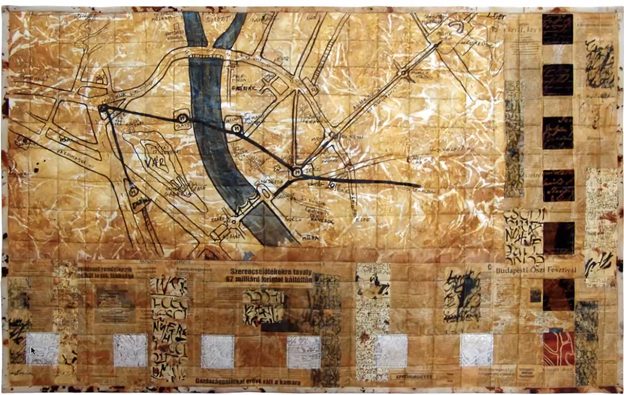
Eszter shared how a simple book of historic city maps sparked a whole new artistic direction. She was drawn not only to their graphic beauty but to what they reveal about the society that built them—how some cities feel chaotic to outsiders while others (hello, Chicago) look like perfect grids. Her early quilt Subjective Mapping enlarged the parts of Budapest where she actually spent her time, while shrinking the areas she rarely visited—a wonderfully honest, biased map of her lived city.
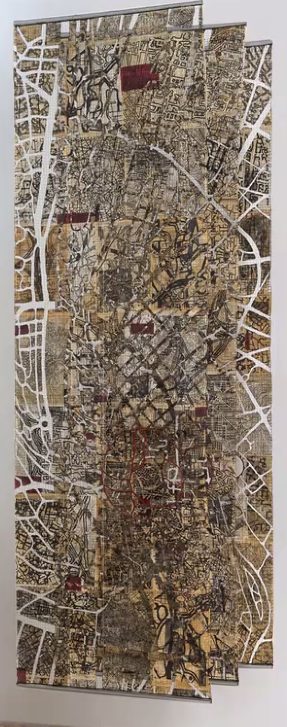
From there, she dove into transparency, layering, and shadow play. Many of her pieces hang several inches off the wall so the shadows become part of the artwork. She experiments with translucent materials, layered maps at different scales, and openings that mimic “the lungs of a city”—green spaces shrinking as development grows.
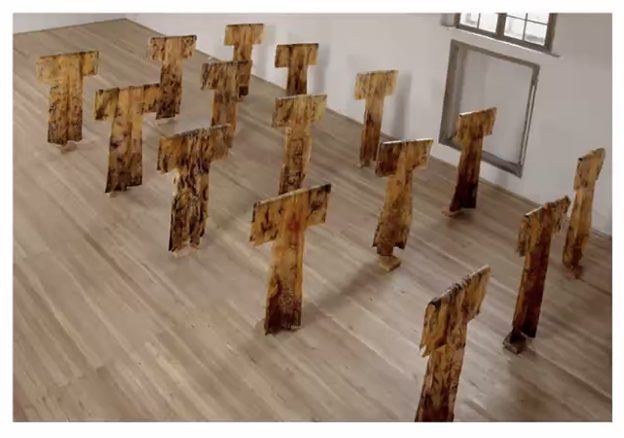
One of her most moving projects came when she was invited to exhibit in an old Hungarian synagogue where she couldn’t put a single nail in the wall. The challenge led her to create freestanding sculptural pieces—tilted shirt-forms standing in rows—honouring the forced marches her father-in-law endured during WWII. The maps printed on the shirts show the routes.
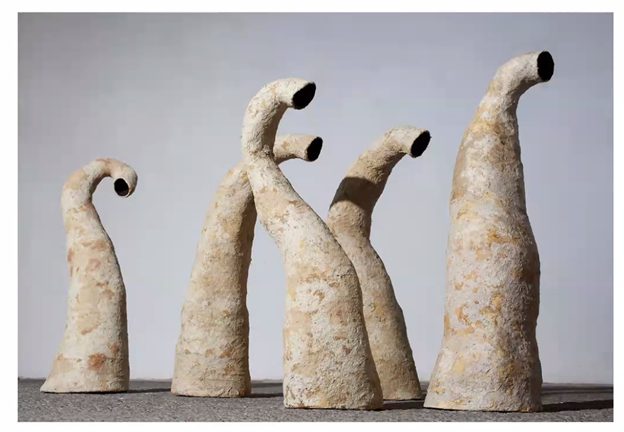
And this is really the heart of Eszter’s work: constant, fearless experimentation. Because she was never formally trained in art or textiles, she simply tries everything. Paper cast over fabric. Chicken wire armatures. Salvaged computer keyboard parts. Japanese papers. Concrete powder. Plastic drop cloths shrunk with a heat gun. Her trial-and-error approach often leads to accidents she embraces—cones collapsing under the weight of wet paper pulp became a whole installation of slumped, expressive “characters,” each with its own personality.
During the pandemic, grounded from travel, she made a whole series of sculptural objects wrestling with themes like misinformation, censorship, and the paralysis of political dysfunction. Other works explore identity through layered silhouettes, or the many “faces” we show (or hide) in different situations—some of these pieces literally rotate on fishing line when someone walks by.
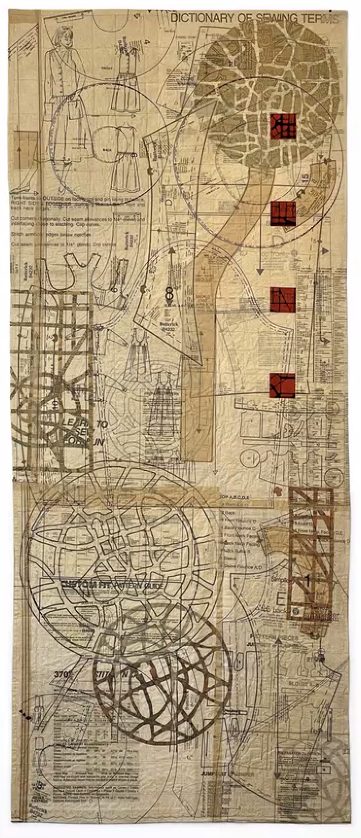
Maps remain a constant thread: cut from newspapers, stitched in dissolvable stabilizer, layered in inverse positives and negatives. Her three-metre-tall panels echo city grids, internal landscapes, and the emotional geography of the places we carry inside ourselves. One ongoing theme is the confusion of seeing multiple maps at once—paper, phone, street sign—each insisting “You are here,” while somehow making you feel even more lost.
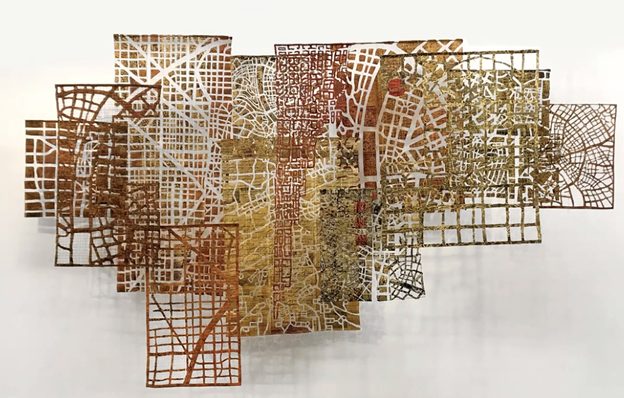
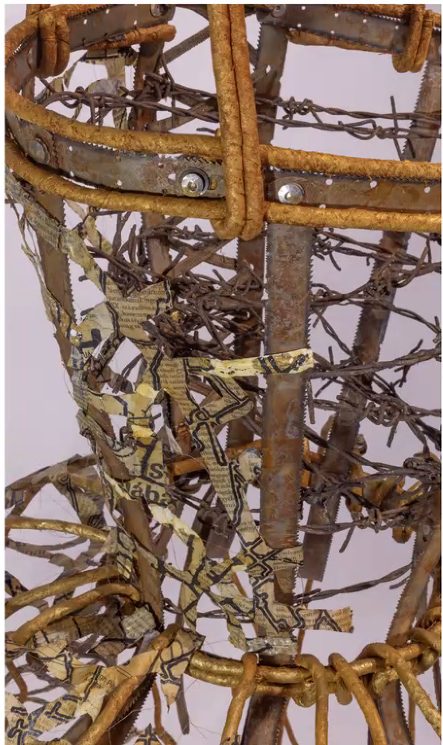
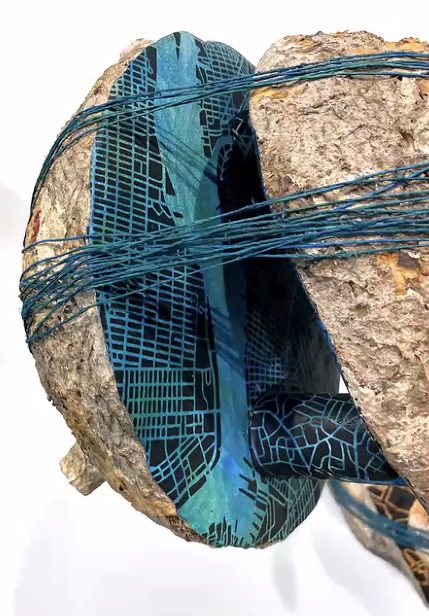
She also shared some recent work, including cracked map-planets for a Shanghai exhibition on water scarcity, a textile “tapestry of Earth” headed to Beijing, and a haunting wire-and-organza dress filled with the “unseen barbs” of sharp words people quietly absorb.
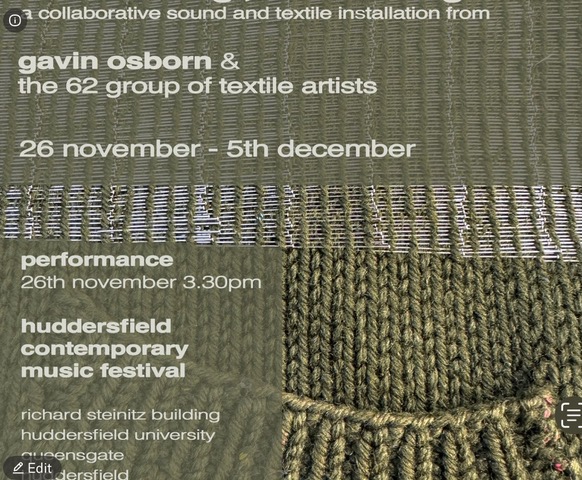
The session ended with lots of admiration (and many practical questions!). Yes—her pieces generally roll up for easy travel. Yes—she cuts maps out by hand with tiny manicure scissors. Yes—her multilayered holes, textures, and lace-like effects come from all kinds of mixed-media processes. She mentioned participation in a recent exhibit of the 62 Group (poster shown here) should you be in the neighbourhood.
It was an inspiring morning with an artist who doesn’t shy away from mess, failure, experimentation, or complexity—and whose work makes you look at cities, maps, and memory in entirely new ways.